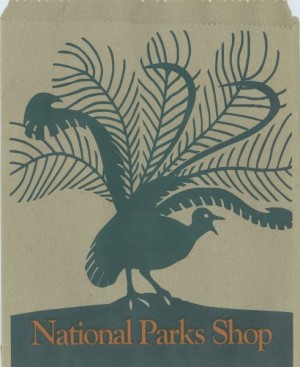

THE LYREBIRD LENDS ITSELF TO STYLISED FORM – AND AS EPHEMERISTS WE MOST OFTEN SEE IT IN TWO DIMENSIONS.
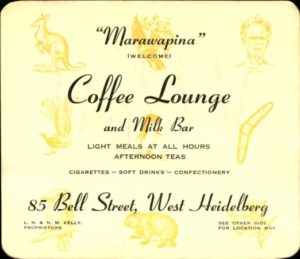
THE REAL SUBJECT OF THIS POST IS A RECORD COVER – AND A RECORDING NOT HEARD BY THE WRITER.
THE RECORDING
The Age Wednesday 28 September 1932, page 8 ran an advertisement – pitching the recording for as a gift to send overseas
A UNIQUE GIFT FOR OVERSEAS. GRAMOPHONE RECORD OF “THE HISTORY AND SONG OF THE LYRE BIRD” AUSTRALIA’S PREMIER SONGSTER AND MIMIC. PRICE. 4/. Specially Packed for Posting, 1/ Extra. From Leading Gramophone Dealers or front the Producers. HERSCHELLS PTY. LTD., Nos. 8 and 9 Railway Buildings, Flinders-street, MELBOURNE.

The Sydney Morning Herald Tuesday 25 October 1932, page 8, reported on:
THE LYRE BIRD.
Record of its Calls. The Song of the Lyre Bird” is the title of an interesting record which reproduces the call of this famous Australian songster. First, the rich notes and a sustained trill are heard, clear, and of beautiful quality; and then follows a series of calls in which other birds are mimicked by the lyre bird. The kookaburra, for instance, is heard beginning its laugh and in a similar way there are snatches of melody caught up from various other birds. Some of these are of a fugitive character, notably the call of the butcher bird; but as examples of mimicry, they are surprisingly good. This novel experiment in recording was organised by Mr C. R. Herschell, of Melbourne, and the record, the label announces, was taken In the Sherbrook Forest, Victoria, under the supervision of Mr Ray Littlejohn. A muffled sound which accompanies the record, is de-scribed as the noise of the forest. The listener is enabled to follow the mimicry by a man’s explanatory calls, and on the reverse there is a brief history of the lyre bird. The record is of great interest as a permanent example of the song of this bird, and should attract attention abroad.
ATTENTION ABROAD – LISTENING TO LYREBIRDS IN THE PHILLIPINES
The recording was added to radio station libraries and played locally and say in Manilla in what seems to be a very busy hour of music sound:
The Tribune (Philippines), Sunday 20 November 1932, page 21
7:30 — 8:30 p.m. — Studio Programme. “No No, Nanette” — Orchestra del Teatro Palace di Londra, Directed by Percival Mackey. Denis Noble — Baritone: “So we’ll go no more A-roving”; ‘The devout Lover.” Maria Gentile and E. de Muro Lomanto: “La Sonnambula.” The Regimental Band of H. M. Grenadier Guards: “A Princess of Kensington.” The History and Song of the Lyre Bird, Australia’s Greatest Songster — Transcribed in the Sherbrook Forest, Victoria, Australia, under the Supervision of Mr. Ray Littlejohns, Member Royal Australasian Ornithologists Union. N. Svilarova and D. Alabiso : “Guarany.” The Regimental Band of H. M. Grenadier Guards : “The Belle of New York ” — Selections. Australia’s Amazing Fauna — By Dr. E. B. Nicholls — Presented by Renn Miller: “The Bird that Laughs” — The Australian Kookaburra — Introduced by Edith Appleton and Terrence Crisp. Arranged and produced by Mrs. Harold W. Clapp. The B.B.C. Symphony Orchestra: “The Bohemian Girl . “
AS INTRIGUING IS THE HISTORY OF THE PUBLISHER – SO PARDON THIS STEP INTO THE CREATOR’S HISTORY…..THE RABBIT HOLE – THE ENTREPENEUR – ABORIGINAL MASSACRE
The publisher was Herschell’s Pty Ltd, chiefly engaged in the cinema. And the founder Mr C. R. Herschell was full of ideas and adventures; eking out a living by documenting Australia. (He was also the agent for Pathe.) Prior to spending time in the tranquility of Sherbrooke Forest Mr Herschell witnessed the aftermath of the Forrest River Massacre.
In 1926 Herschell made some important recordings – I wonder if they survive. In May 1926, he was on a long tour “taking in Broome, Derby, Hall’s creek, Wyndham in the far North West, Darwin and Catherine River in the Northern Territory, Thursday Island and Mitchell River in the Gulf Country….The Australian Board of Missions has commissioned Mr Herschell to take 10,000 ft of film of their mission activities… Interesting studies of aboriginal life will be included in the pictures”.
- In June 1926, a local farmer, Frederick Hay was killed in the Kimberley;
- A police group followed up the murder and this led to The Forrest River massacre, also called the Oombulgurri massacre, happened. A Royal Commission was set up in 1927 to look into it more deeply. This inquiry found that twenty Aboriginal people were murdered and burned in different places.
In the weeks after the police operation ended, several Aboriginal people came to the Forrest River mission with bullet wounds. C. R. Herschell, who worked for Pathé films, was visiting the mission at that time. He took many photographs and movie films of the wounded survivors and their sad relatives.
(Source of information here https://kids.kiddle.co/Forrest_River_massacre)
Many films produced by Herschells are kept by the National Film and Sound Archive. I am trying to donate this record – which I found at an op shop – to them, Mandy Bede.
Kristen says
great find Mandy! we’ve got a copy at Deakin – https://library.deakin.edu.au/record=b3278056~S1 – but ours doesn’t have a sleeve, so I’d take it for here if your other donation options fall through (we’ve actually digitised it – it’s very entertaining – we’re trying to work out how to make it public; when our data store options get sorted, hopefully that will happen!)
Kristen
mbede says
Thanks I’ll keep your library in mind.
And it was a great find – you can do a lot if looking for the odd really good find.